The Law of Shitty Clickthroughs

The first banner ad ever, on HotWired in 1994, debuted with a clickthrough rate of 78% (thanks @ottotimmons)
First it works, and then it doesn’t
After months of iterating on different marketing strategies, you finally find something that works. However, the moment you start to scale it, the effectiveness of your marketing grinds to a halt. Sound familiar?
Welcome to the Law of Shitty Clickthroughs:
Over time, all marketing strategies result in shitty clickthrough rates.
Here’s a real example – let’s compare the average clickthrough rates of banner ads when debuted on HotWired in 1994 versus Facebook in 2011:
- HotWired CTR, 1994: 78%
- Facebook CTR, 2011: 0.05%
That’s a 1500X difference. While there are many factors that influence this difference, the basic premise is sound – the clickthrough rates of banner ads, email invites, and many other marketing channels on the web have decayed every year since they were invented.
Here’s another channel, which is email open rates over time, according to eMarketer:
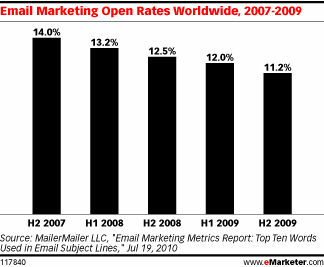
While this graph shows a decline, the other graph (which I don’t have handy) is that the number of emails sent out has increased up to 30+ billion per day.
All these channels are decaying over time, and what’s saving us is the new marketing channels are constantly getting unveiled, too. These new channels offer high performance, because of a lack of competition, big opportunities for novel marketing techniques, and these days, the cutting edge is about optimizing your mobile notifications, not your banner placements.
There are a few drivers for the Law of Shitty Clickthroughs, and here’s a summary of the top ones:
- Customers respond to novelty, which inevitably fades
- First-to-market never lasts
- More scale means less qualified customers
Novelty
Without a doubt, one of the key drivers of engagement for marketing is that customers respond to novelty. When HotWired showed banner ads for the first time in history, people clicked just to check out the experience. Same for being the first web product to email people invites to a website – it works for a while, until your customers get used to the effect, and start ignoring it.
One of the most important tools you have at your disposal is the creative and calls to action that you use in your marketing – this might be like “X has invited you to Y” or it might be the headline you use in your banner ads. Recently, Retargeter posted an interesting analysis on the Importance of Rotating Creatives, which showed how keeping the same ad creative led to declining CTRs over time:

Publishers often have a similar problem in consumers ignoring the advertising on their site, which drives down clickthrough rates for both of them (bad for CPMs). This problem is often described as banner blindness, and you can see it clearly here in an eye-tracking study by Jakob Nielsen:

You can see here how users, almost comically, avoid looking at any banners.
The point is, humans seek novelty yet are pattern-recognition machines. Your initial marketing strategy will work quite well as your users try it for the first time, but afterwards, they learn to filter your marketing efforts out unless they are genuinely useful (more on that later).
First-to-market never lasts
It’s bad enough that your own marketing efforts drive down channel performance, but usually once your marketing efforts are working, your competitors quickly follow. There’s a whole cottage industry of companies that provide competitive research in the area of how their competitors are advertising and give you the information needed to fast-follow their marketing efforts.
For example, with a quick query, I know how much Airbnb is spending on search marketing (turns out, millions per year) what keywords they are buying ads on, and who their competitors are. And this is just a free service! There are much more sophisticated products for every established marketing channel:
Airbnb Search Engine Marketing
- Daily ad budget: $10,638
- Keywords: 62,729
- Example ad: Find Affordable Rooms Starting From $20/Day. Browse & Book Online Now!
- Main competitors: Expedia.com, booking.com, hotels.com, Marriott.com
Any clone of their business can quickly fast-follow their marketing efforts and use the same ads in the same marketing channels. This quickly degrades the performance of the marketing channel as the novelty wears off and clickthroughs plummet.
Any product that is first to market has a limited window where they will enjoy unnaturally high marketing performance, until the competition enters, in which case everyone’s marketing efforts will degrade.
More scale means less qualified customers
Another important way to think about the available market for your product is in terms of the popular Technology Adoption Lifecycle, in which early adopters actively seek out your product, while the rest of the mainstream market needs a lot of convincing. The quant marketing way to look at this is that early adopters respond better to marketing efforts across any given metric (signup %, CTR, CPA) than the later customer segments. In the TAL framework, the early market seeks out novelty, whereas the mainstream market just cares if you solve a problem for them.
As a result, a marketing strategy focused on early adopters is bound to look better than what you get later. You can get some limited traffic from PR and targeted advertising from niche communities and media properties. However once you get past this group, the CTRs can drop substantially.
If you’re a SaaS or ecommerce company that’s road-tested your marketing strategy by acquiring limited batches of customers, the problem is that whatever assumptions and projections you make off of this base end up fundamentally skewed positive. If your model indicates that you can acquire customers at $10 and break even within 6 months, it’s not hard for a 30% increase in CAC and 30% decrease in LTV to double the time it takes to get to profitability. This could be the difference between life and death for a company.
Lesson to investors is: Beware marketing metrics done at a small scale, and beware marketing tech companies that facilitate momentary marketing opportunities without a bigger vision. These are arbitrage opportunities that will disappear over time.
How to fight the Law of Shitty Clickthroughs
I call it a Law, of course, because I really believe it’s a strong gravitational pull on all marketing on the web. You can’t avoid it, and in many ways, it’s counter productive to try.
You can always get incrementally better performance out of your marketing by taking a nomad strategy – always keep developing new creative, testing new publishers, and so on. That’s all easy, but is mostly about maintaining some base level of performance. This can push the Law of Shitty Clickthroughs to act over years rather than degrading your marketing efforts over months.
Similarly, this law provides a litmus test as to the difference between advertising and information. When you are marketing with useful information, then CTRs stay high. Advertising that’s just novelty and noise wrapped in a new marketing channel has a limited shelf life.
The real solution: Discover the next untapped marketing channel
The 10X solution to solving the Law of Shitty Clickthroughs, even momentarily, is to discover the next untapped marketing channel. In addition to doubling down on traditional forms of online advertising like banners, search, and email, it’s important to work hard to get to the next marketing channel while it’s uncontested.
Sometimes I get asked “have you ever seen someone do XYZ to acquire customers?” Turns out, the highest vote of confidence I can give is, “No I haven’t, and that’s good – that means there’s a higher chance of it working. You should try it.”
Today, these (relatively) uncontested marketing channels are Open Graph, mobile notifications, etc. If you can make these channels work with a strong product behind it, then great. Chances are, you’ll enjoy a few months if not a few years of strong marketing performance before they too, slowly succumb.
PS. Get new updates/analysis on tech and startupsI write a high-quality, weekly newsletter covering what's happening in Silicon Valley, focused on startups, marketing, and mobile.
Views expressed in “content” (including posts, podcasts, videos) linked on this website or posted in social media and other platforms (collectively, “content distribution outlets”) are my own and are not the views of AH Capital Management, L.L.C. (“a16z”) or its respective affiliates. AH Capital Management is an investment adviser registered with the Securities and Exchange Commission. Registration as an investment adviser does not imply any special skill or training. The posts are not directed to any investors or potential investors, and do not constitute an offer to sell -- or a solicitation of an offer to buy -- any securities, and may not be used or relied upon in evaluating the merits of any investment.
The content should not be construed as or relied upon in any manner as investment, legal, tax, or other advice. You should consult your own advisers as to legal, business, tax, and other related matters concerning any investment. Any projections, estimates, forecasts, targets, prospects and/or opinions expressed in these materials are subject to change without notice and may differ or be contrary to opinions expressed by others. Any charts provided here are for informational purposes only, and should not be relied upon when making any investment decision. Certain information contained in here has been obtained from third-party sources. While taken from sources believed to be reliable, I have not independently verified such information and makes no representations about the enduring accuracy of the information or its appropriateness for a given situation. The content speaks only as of the date indicated.
Under no circumstances should any posts or other information provided on this website -- or on associated content distribution outlets -- be construed as an offer soliciting the purchase or sale of any security or interest in any pooled investment vehicle sponsored, discussed, or mentioned by a16z personnel. Nor should it be construed as an offer to provide investment advisory services; an offer to invest in an a16z-managed pooled investment vehicle will be made separately and only by means of the confidential offering documents of the specific pooled investment vehicles -- which should be read in their entirety, and only to those who, among other requirements, meet certain qualifications under federal securities laws. Such investors, defined as accredited investors and qualified purchasers, are generally deemed capable of evaluating the merits and risks of prospective investments and financial matters. There can be no assurances that a16z’s investment objectives will be achieved or investment strategies will be successful. Any investment in a vehicle managed by a16z involves a high degree of risk including the risk that the entire amount invested is lost. Any investments or portfolio companies mentioned, referred to, or described are not representative of all investments in vehicles managed by a16z and there can be no assurance that the investments will be profitable or that other investments made in the future will have similar characteristics or results. A list of investments made by funds managed by a16z is available at https://a16z.com/investments/. Excluded from this list are investments for which the issuer has not provided permission for a16z to disclose publicly as well as unannounced investments in publicly traded digital assets. Past results of Andreessen Horowitz’s investments, pooled investment vehicles, or investment strategies are not necessarily indicative of future results. Please see https://a16z.com/disclosures for additional important information.